Cairns, carneddau, and the habit of marking a life with stone
Kitty, Carn · 2 September 2026 · 3 min read
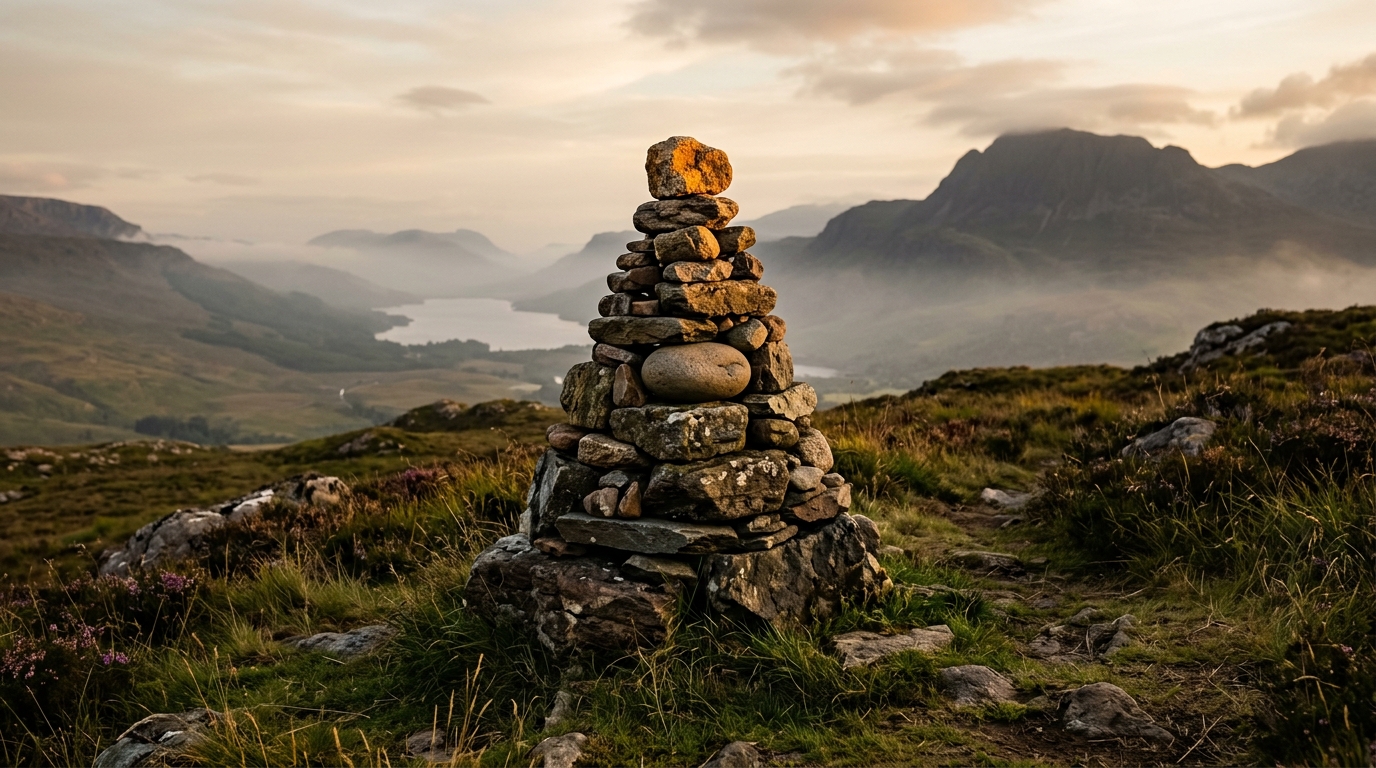
Walk up almost any mountain in Wales and you will find a heap of stones at the top. Some are Bronze Age burial cairns, four thousand years old. Some were built last summer by people who fancied adding a stone.
The word is *carn* in Welsh and in Scottish Gaelic, plural *carneddau*. Two of Britain's oldest living languages, and the same idea: a pile of stones put there by human hands to mark a place, honour a life, or guide whoever comes next.
Nobody builds a cairn alone
That is the part that stays with me. A cairn is not a monument in the usual sense. Nobody commissioned it, nobody signed it, and no single person could have carried enough stone to build one.
It exists because hundreds of people, across years, each stopped and added one stone. Every one of those stones is somebody saying: I came up here. I knew about this. It mattered enough to bend down.
The result is a structure whose size is a direct measure of how many people cared, built by people who mostly never met each other.
Why stone
The practical answer is that it is what was to hand on a mountain. The better answer is that stone outlasts the person who placed it, and everybody placing one knows that.
There is a tradition in Jewish practice of leaving a small stone on a grave when you visit, rather than flowers. The usual explanation given is that flowers fade and stones do not. The visit is recorded. The next person to come sees that somebody was here.
Very different cultures, thousands of miles apart, arrived at the same gesture. It is hard not to conclude that the impulse is fairly deep in us.
What this has to do with a website
Carn began as one page, built for one family after a friend died. It was meant to be somewhere to put the photographs, and within a week it had turned into something else: people were writing things nobody in the family had ever heard.
A man he had worked with in the nineties. Someone he had taught to drive. A neighbour with a story about a broken fence that made everyone cry with laughter at exactly the point in the year when nobody had laughed for a while.
None of those people would have described themselves as close enough to matter. Each of them had one stone to add, and had assumed it was too small to be worth the bending down.
Every memory placed is somebody saying: I was here. I knew this person. I wanted to mark that they mattered.
The free part is not a marketing decision
People ask why the first ninety days cost nothing, and whether that is a funnel.
It is not, particularly. The fortnight after a death is the worst possible moment to put a payment page in front of somebody, and a memorial that only exists if a grieving family can find a card is not a memorial, it is a product.
Gathering what people remember should start on the day it occurs to you, not on the day the estate is settled. Everything after that — keeping it permanently, printing it, the rest of it — can be a thing you decide later, when you are able to decide things.
What we are actually trying to build
Not a website with a memorial on it. A cairn: something a lot of people each add a small piece to, which ends up larger than any of them could have made alone, and which is still there when they are not.
If you have ever added a stone to a pile at the top of a hill, you already understand what we are asking people to do. It is the same gesture. It just happens to be typed.
Kitty — Kitty writes and edits the Carn journal.
Also worth reading
What to write in a memorial message when you didn't know them well
You worked with him for two years, or you were her neighbour for a decade. You are not family. Here is what to write, and why the small things are the ones worth saying.
"Sorry for your loss" and what to say instead
The phrase is not wrong, it is just worn smooth. Here is why it lands the way it does, and a handful of things to say that people actually remember.
How to collect photographs from family before a funeral
You have four days, a slideshow to build, and eleven people who all say they will "have a look tonight". A practical method that gets you the pictures.
Gather what people remember
One link, one QR code, and anyone who loved them can add a memory from their phone. Free for the first 90 days.