Making a memory book: what to include and what to leave out
Kitty, Carn · 3 September 2026 · 3 min read
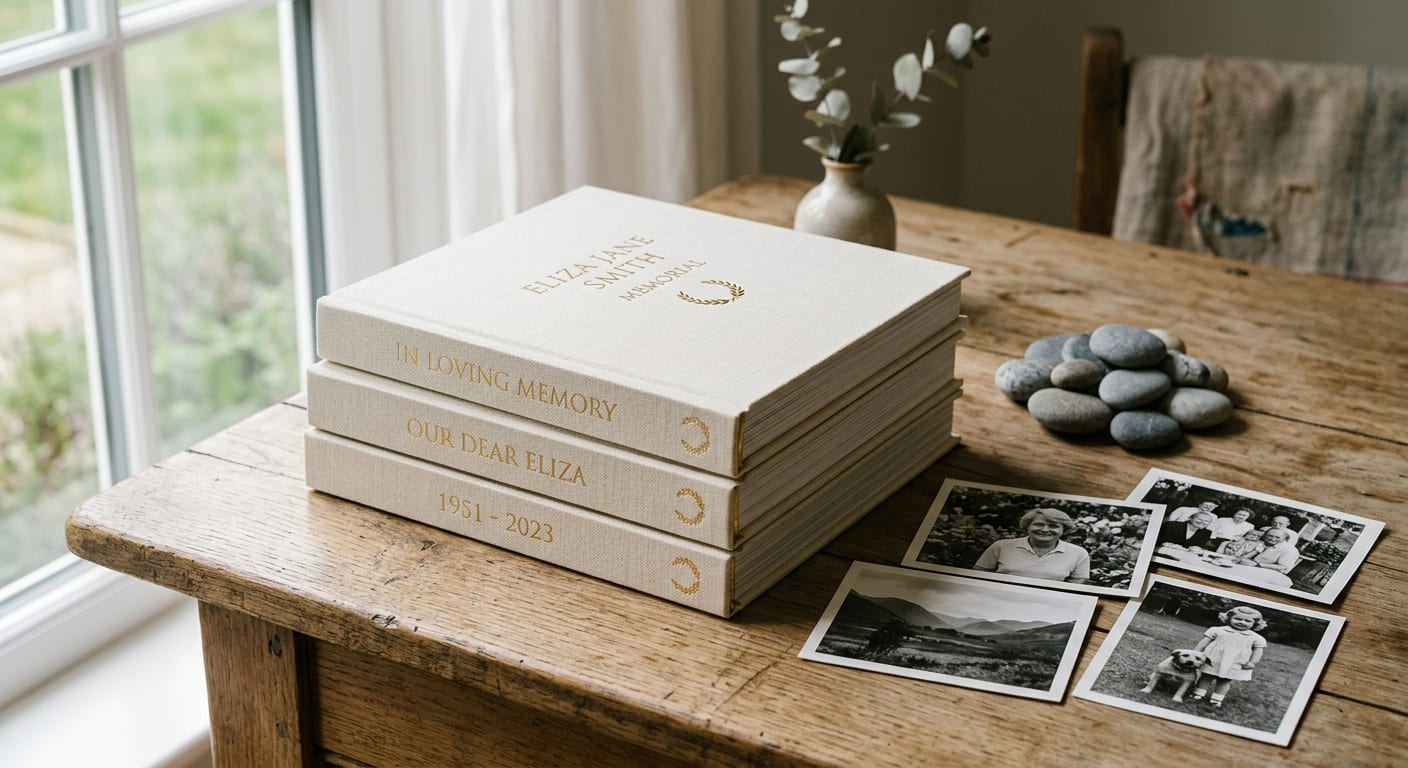
At some point after a funeral, somebody in the family says they should make a book. Then it sits for two years, because the question of what actually goes in it is harder than it sounds.
Here is a working answer, from families who have done it.
The spine of it
The strongest books have four things, in roughly this order:
- ● A short opening that says who this was, in the family's own words. Half a page, not a biography.
- ● What other people remembered, in their own voices, with their names attached.
- ● Photographs, with captions that say when and where and who else is in them.
- ● A closing list of everyone who contributed.
That last page matters more than people expect. It is a record of how many people this person mattered to, and it is often the page that gets looked at longest.
Leave the voices as they are
The temptation is to edit everything into one register. Resist it. A book where the grandchild sounds like the colleague sounds like the vicar is a book about nobody.
Fix an obvious typo. Leave the odd phrasing, the sentence that trails off, the joke that only half works. That is what makes it read like people rather than like a brochure.
Say when and where
A photograph of a man on a beach is a man on a beach. "Barmouth, 1994, the year the car broke down on the way" is the story.
If nobody can remember the year, write what you do know. "Sometime in the late seventies, judging by the curtains" is a better caption than nothing, and it sounds like the family.
What to leave out
Three things, generally.
Anything that settles a score. A memory that exists to make a point about someone still living does not belong in a book that will be on a shelf for forty years.
Medical detail. The last months are often the most vivid for the people who were there, and almost never what anyone wants to read at length later. A line is enough, if you want one at all.
Anything a contributor would be upset to see printed. People write differently in a private message than they would for a book. If something feels confessional, ask them before including it.
The awkward ones
Every family has at least one. The ex-wife of twenty years who was there for most of his life. The estranged son. The friend nobody else liked. The colleague who writes something lovely and slightly wrong.
The general principle that holds: the book is about the person who died, not about the current state of the family. If someone was genuinely part of that life, their contribution probably belongs, even if it makes someone uncomfortable.
The exception is anyone whose presence would stop the family from being able to open the book at all. You are making something that will be read. A book nobody can bear to look at has failed, however fair it is.
One practical route: give the difficult contribution its own page rather than sitting it next to a widow's. Position does a lot of the diplomatic work.
How long to wait
Longer than you think. Memories keep arriving for a year or more, and the ones that come in month eight are frequently better than anything from week two, because the people who were closest were too flattened to write early on.
Many families end up making two: one soon after, while everyone is gathered and the details are sharp, and a fuller one on the first anniversary. There is nothing wrong with that. It is not a single shot.
Print more than one
The commonest regret is ordering a single copy. There is always a sibling, a grandchild or a friend who ends up wishing they had one, and reprinting years later means finding all the files again.
Three is usually the right number. It is also, not coincidentally, how families most often order the Carn memory book: one for the house, two for the people who could not be there.
Kitty — Kitty writes and edits the Carn journal.
Also worth reading
The first birthday after: what families actually do
The date arrives whether you plan for it or not. What other families have found bearable, and permission to do none of it.
What to write in a memorial message when you didn't know them well
You worked with him for two years, or you were her neighbour for a decade. You are not family. Here is what to write, and why the small things are the ones worth saying.
"Sorry for your loss" and what to say instead
The phrase is not wrong, it is just worn smooth. Here is why it lands the way it does, and a handful of things to say that people actually remember.
Gather what people remember
One link, one QR code, and anyone who loved them can add a memory from their phone. Free for the first 90 days.